
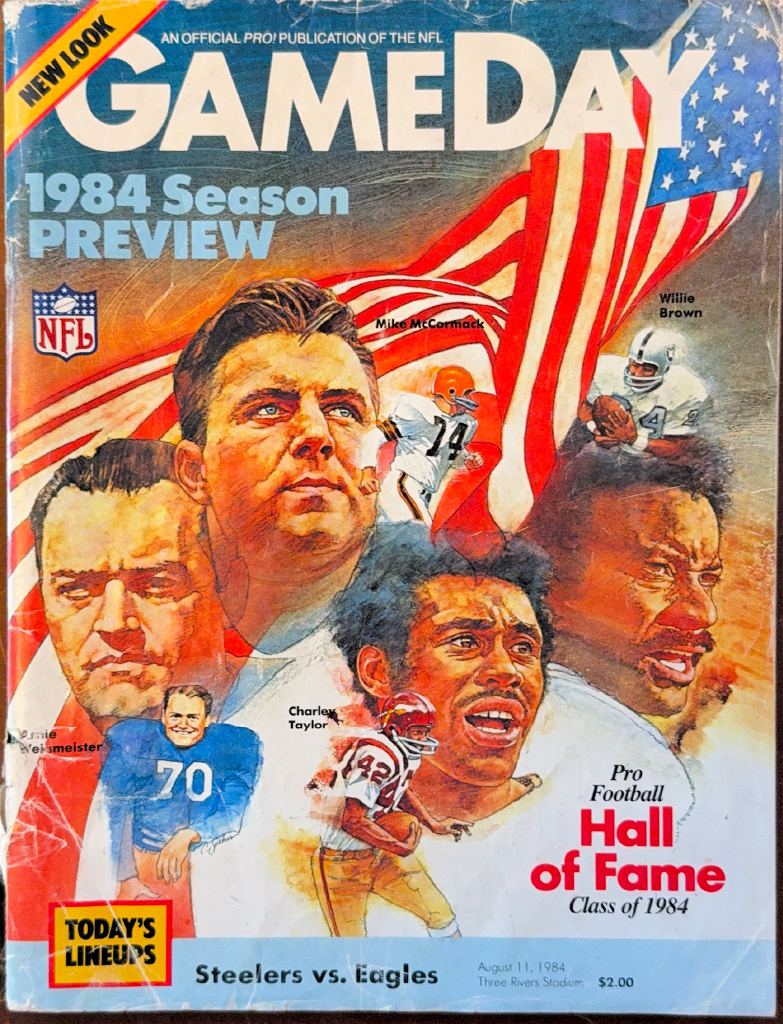
A single program I kept from a 1984 preseason night at Three Rivers Stadium taught me what football print once understood — the game deserves artifacts, not just information.
Football People Keep Things
Football people keep things.
Some keep game balls. Some keep playbooks. Some keep ticket stubs pressed into the back of a drawer, or scouting notes, or a wristband cut off after a game and never worn again, or a laminated sideline pass gone soft at the corners. But there is a certain kind of football person who keeps the programs.
That person understands something the box score never says out loud: a football game is never just a score. It is a night. A stadium. A city holding its breath. A cast of characters who will never again stand on the same field at the same time. A style of play that belonged to one era and no other. A brief intersection of lives that will not happen that way again, no matter how many times you run the film back.
The humble game program is the one object that tries to hold all of that at once.
August 11, 1984
On August 11, 1984, the Philadelphia Eagles played a preseason game against the Pittsburgh Steelers at Three Rivers Stadium.
On paper, it was just a preseason game. One more date in August. One more stop in camp. One more chance to make an impression and hold onto a roster spot while the heat came off the artificial turf in waves.
But football is almost never just what it says on the schedule.
For me, that night carried a weight that had nothing to do with the standings. I grew up in Shadyside, Ohio — a small Ohio River town about an hour west of Pittsburgh, close enough that the mills and the games were part of the air you breathed. In that part of the world, people grew up one of two things: Steelers fans or Browns fans. The line ran through families and friendships and Friday-night arguments, and everybody knew which side they were on.
I was not a Steelers fan. But like anyone who grew up in that region, I understood exactly what Chuck Noll had built in Pittsburgh. You did not have to claim the team to respect the dynasty — the discipline, the four Super Bowls, the aura that walked into a stadium ahead of the players. That respect was simply part of being from there.
And now I was on the field at Three Rivers, in an Eagles uniform, looking up at a building I had watched my whole life on Sunday television.
You did not have to claim the team to respect the dynasty. That respect was simply part of being from there.
Family and friends came that night because my name was on the roster. They drove an hour east into the city — some of them lifelong Steelers people — not to see the black and gold, but to see one of their own on a field they had known since childhood. A few of them had never been to an NFL game in their lives. They came for a preseason exhibition because, for one night, the roster in the program had a name from home in it.
That alone would have made the night unforgettable.
But what stayed with me, in the end, was the program.
The One I Kept
Out of all the games, all the travel, all the paper that passes through a football life — the depth charts, the flight itineraries, the scouting sheets, the game programs handed out by the thousands — this is the only one I kept.
At first the reasons were instinctive more than analytical. The photographs were strong; the players and coaches had a presence on the page that felt earned, not staged. The layout felt intentional, built by someone who cared where the eye landed. The whole object felt substantial in the hand, the way a good hardcover feels different from a paperback before you have read a word.
The cover price was two dollars.
What was inside was worth far more than that.
This was not a flimsy throwaway, folded for convenience and abandoned under a stadium seat by halftime. It was assembled with care. The roster pages mattered. The editorial pages mattered. Even the advertising felt like part of the night rather than an interruption of it.
Zenith pushed its "Smart Set" televisions hard. Sony's Betamax players appeared like emblems of a modern future that was, at that moment, still arriving. And Elby's Big Boy — the local restaurant chain woven into the fabric of Ohio Valley weekends — took a prominent ad, the kind of detail that instantly fixes an object in one geography and one year and no other.
That is part of what a good program does. It does not just tell you who played. It tells you where the game lived.
Inside the NFL
One of the smartest sections in that program was a feature called Inside the NFL.
That night's article was titled "Screen Pass Still a Weapon Despite Misfire," written by Rick Gosselin. It was not fluff and it was not filler. It was a real football piece, the kind you would expect from a serious magazine, tucked inside a two-dollar preseason program.
The story broke down screen strategy the way serious football people recognize and appreciate immediately — when it works, when it fails, and why it still mattered in an era when defenses were getting faster and offenses were being forced to evolve. There were aerial photographs of the screen game developing from above, so you could see the timing and the spacing the way a coach sees it in the box. There were diagrams of different variations used around the league: the quick screen, the hurry-up sweep, the read screen.
That mattered.
It meant the program respected the intelligence of the reader. It assumed a fan might actually care how the screen game worked, why it endured, and how teams were teaching it. It treated strategy as editorial material worthy of print — not a highlight, not a hot take, but a lesson.
For a young player and future coach, that kind of content was gold. For a publisher, decades later, it is instruction. It proved that even a game program could be more than ceremonial. It could teach. And that is one of the reasons the best football print still holds up: it gives you something to return to besides nostalgia.
The program respected the intelligence of the reader.
The Names on the Page
Time changes the meaning of a roster.
In August 1984, the names in that program were simply names. Positions. Numbers. Colleges. A staff list. A team trying to get itself ready for a season. Nothing on the page announced itself as history.
But years later, the same roster reads like a prophecy nobody knew they were writing.
On that 1984 Eagles squad was a linebacker named Bill Cowher — at the time a special-teams and depth-chart player fighting to hold a job like everyone else. He would go on to become the head coach of the Pittsburgh Steelers, succeed Chuck Noll on that very sideline, win a Super Bowl, and take his place in the Hall of Fame.
Herm Edwards was there too, a defensive back on that same Eagles team, steady and respected in the secondary. He would become an NFL head coach and, later, one of the most recognizable voices in the American football conversation.
And on the staff chart was Ted Marchibroda, the Eagles' offensive coordinator that season, installing a new system and shaping the identity of the offense from behind the scenes. Marchibroda's own career would branch into a coaching tree that touched franchises and quarterbacks for a generation.
The remarkable thing is not simply that those names were in the program.
The remarkable thing is that the program held them all on the same pages — in the same plain columns, in the same ink as the players who never made a final roster — long before the football world had any idea what they would become. No asterisk. No annotation. No "future Hall of Fame coach." Just a name, a number, a height, a college, frozen in place for one night in August.
The program had them all on the same page long before the football world knew what they would become.
That is what a program does at its best. It captures people before their stories are finished being written.
Paper Architecture
Programs reveal the structure beneath the spectacle.
Not in the literal sense of concrete and steel, but in the sense that they show you the scaffolding a broadcast hides. The assistants listed in small type. The coordinators. The players fighting for the last two spots. The businesses buying the ad space. The editorial priorities of the franchise. The vocabulary of the era, and the visual language of football back when it still looked like a place instead of a template.
That August 1984 program showed all of it.
It showed a league that still believed strategy belonged in print. It showed a city selling televisions and Betamax machines to football fans on their way home. It showed a restaurant like Elby's Big Boy claiming its stake in the weekend ritual. It showed coaches and players not yet frozen into legend — still listed in plain columns, indistinguishable from the men beside them who would be cut in a week.
That is why a program is more than a souvenir.
It is paper architecture — the structural record of how the game chose to present itself to the public on one very specific day. Read it closely and you are not looking at a keepsake. You are reading a blueprint of a moment.
A Night Image That Never Left
There is one image from that night that has stayed with me as sharply as anything printed inside the program — sharper, maybe, because no one printed it at all.
Late in the game, with the outcome long decided and the stadium lights burning against the dark, I looked across the field. Away from the clustered players, away from the coaches and the trainers and the noise of a team packing itself up, a single figure sat alone on his helmet.
It was Jack Lambert.
He was sitting there casually, a little apart from everyone, smoking a cigarette into the nighttime sky over Pittsburgh — the steel-mill glow of the city hanging somewhere out beyond the rim of the stadium. He was not performing. He was not aware of being watched. He was simply a man at the end of a long night, doing exactly as he pleased, and the whole scene belonged so completely to that era and to that man that it stopped me where I stood.
Growing up, no coach I had ever played for would have tolerated a player sitting on his helmet, let alone lighting a cigarette on the field. It was unthinkable. It would have gotten you run until you were sick. But this was Jack Lambert — Dracula in cleats, the snarling middle of the Steel Curtain, the most intimidating linebacker of his generation — and somehow, watching him, it made perfect sense. He had earned the right to sit alone for a moment at the edge of the game.
It was awe-inspiring, and it was also something else: it was an ending, though I did not have the words for it then. In that single image you could see the old NFL and the new one overlapping — the last embers of a grittier, unpolished era on one side of the field, and on the other, a locker room full of young players like me fighting to belong to whatever came next.
In one image, you could see the old NFL and the new one overlapping — the last embers of a grittier era, and the beginning of everything that came after.
The program does not show that cigarette. It does not show Lambert seated on his helmet in the quiet after the violence. But it carries his name, his number, his place in the architecture of that night.
The rest lives in memory.
The program is what keeps the memory anchored.
Why This One Survived
This particular program survived because it was beautifully made. Because the photography had authority. Because the writing treated football as something worth understanding. Because the details — the ads, the diagrams, the staff lists — all mattered to someone before they mattered to me.
But it survived, too, because it captured a night where my own life intersected with a storied stadium, a hometown region, a great franchise, a page full of future head coaches, and one unforgettable figure sitting alone across the field.
And it survived because, somewhere along the way, it taught me a lesson I have carried into everything I have built since.
Football deserves to be printed well.
Not merely recorded. Not merely updated. Not merely uploaded and pushed and refreshed and forgotten. Printed. Because when football is printed with seriousness, it becomes something a screen can never be. It becomes a physical record of a culture. A keeper of names. A vessel for memory. A thing you can pull off a shelf twenty or forty years later and still learn from — still be surprised by.
The game deserves artifacts, not just content.
From a Two-Dollar Program to Gridiron Aficionado
For Gridiron Aficionado, the art of the football program is not nostalgia. It is a blueprint.
The best programs understood that football was never just a game. It was a world — a culture, a strategy conversation, a civic ritual, a collection of objects and images and names that deserved to be presented with care. That is the spirit behind this magazine.
The goal is not to publish football content. The goal is to make something worthy of being kept. Something that, years from now, can be pulled from a shelf the way that 1984 program was pulled from a box — and still reveal something new. A future legend in plain columns. A forgotten player. A regional sponsor that no longer exists. A tactical diagram from a night when the league still believed fans wanted to learn. A moment in the game before anyone knew what came next.
That is the art of the football program.
And it is one of the reasons this magazine exists at all.